


Looking to start your CAT 2026 prep and already feeling exhausted after checking out the Quantitative Aptitude syllabus? Well, worry not. CAT is not like a regular exam where you have to cover every inch of the syllabus to score well. It requires a smart approach — the approach of the strategic backbencher — which is to cover the important topics. And even within those important topics, CAT gives you the flexibility to choose the ones you are most comfortable with.
So let’s break down exactly how to score 99 percentile in the QA section — topic by topic, strategy by strategy.
This guide covers the QA section in depth. If you are looking for a complete overview of all three CAT sections — including the 10-10-10 strategy, the full 3-phase preparation roadmap, and advice for non-engineers — start here:
Breakdown of Past Year Trends in CAT Quantitative Aptitude
Before diving into strategy, you need to understand the terrain. The table below is based on official CAT question papers and analysis, and it tells you exactly where the 22 QA questions come from every year.
|
Core Topics & Modules |
2025 |
2024 |
2023 |
3-Year Avg |
|
ARITHMETIC |
9.0 |
8.3 |
8.7 |
8.7 |
|
3.0 |
2.0 |
3.0 |
2.7 |
|
|
Averages, Ratio & Proportion, Percentage, Mixture & Alligation |
4.0 |
4.0 |
2.7 |
3.6 |
|
2.0 |
2.3 |
3.0 |
2.4 |
|
|
ALGEBRA |
7.0 |
7.0 |
7.3 |
7.1 |
|
4.7 |
2.3 |
3.7 |
3.6 |
|
|
Logarithms, Surds & Indices |
1.3 |
2.3 |
1.3 |
1.6 |
|
Progressions, Series, Functions & Graphs |
1.0 |
2.4 |
2.3 |
1.9 |
|
GEOMETRY & MENSURATION |
3.0 |
3.3 |
3.7 |
3.3 |
|
Triangles, Circles & Polygons |
2.0 |
2.3 |
2.7 |
2.3 |
|
Coordinate Geometry & Mensuration |
1.0 |
1.0 |
1.0 |
1.0 |
|
NUMBER SYSTEM |
2.0 |
2.3 |
1.3 |
1.9 |
|
MODERN MATH (P&C, Probability, Sets) |
1.0 |
1.0 |
1.0 |
1.0 |
|
TOTAL QUESTIONS |
22 |
22 |
22 |
22 |
Source: IIM CAT Official Portal — question paper analysis across CAT 2023, 2024, and 2025 slots.
The numbers above tell a clear story. Let’s visualise it.
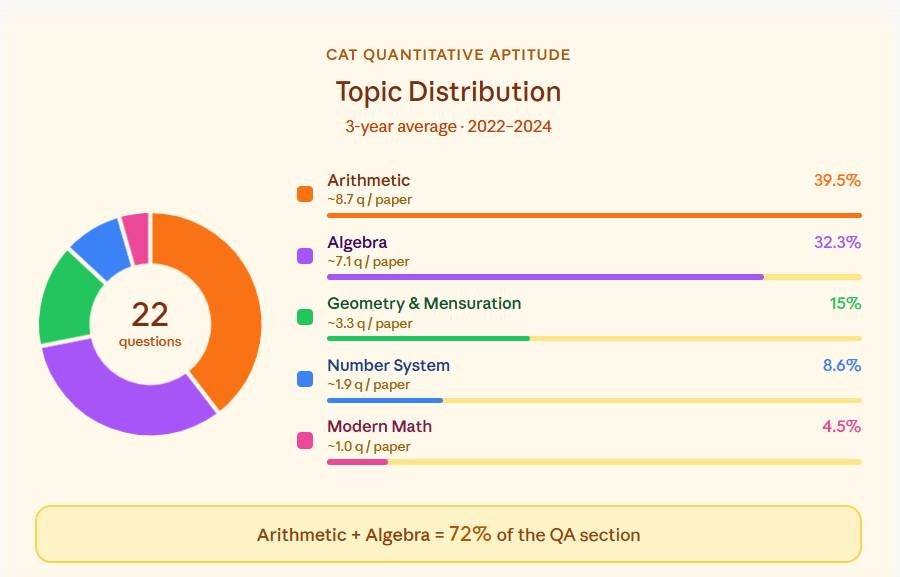
The takeaway is hard to ignore: Arithmetic alone accounts for nearly 40% of the QA section every single year, without exception. If you master nothing else, master Arithmetic.
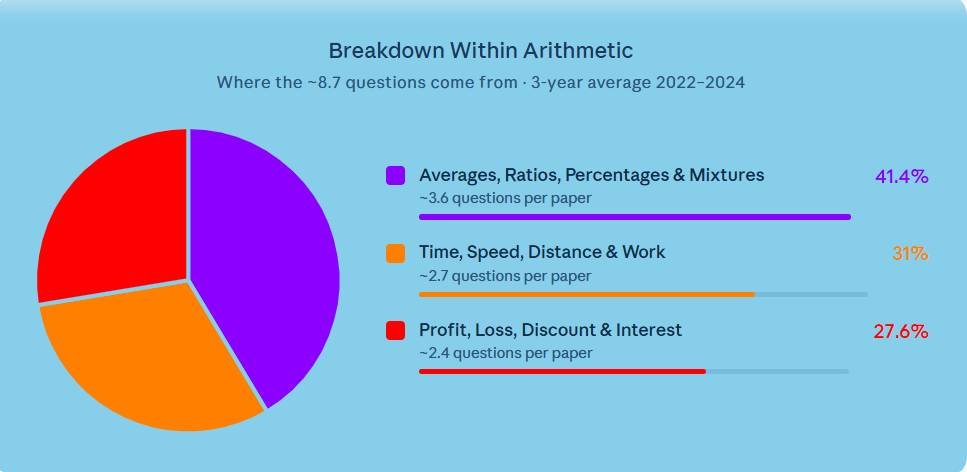
Arithmetic is not just the biggest chunk — it is also the most forgiving chunk to prepare. Unlike Geometry or Modern Math, which have wide syllabi and unpredictable question types, Arithmetic has a tightly defined topic set. Percentages, Ratios, Time-Speed-Distance, Averages, Profit-Loss — the same building blocks, recombined in different ways year after year. A student who builds deep comfort in these topics has a reliable, repeatable score floor.
“Hemant, a former student of CAT 2025 told us that they spent the first two months almost exclusively on Arithmetic. ‘I kept thinking I should move on to harder topics, but my mentor told me to stay put. By the time I finally moved to Algebra, I was solving Arithmetic questions in under 90 seconds on average. That speed is what eventually gave me the time to attempt Geometry too.’”
A note on Geometry: It looks important on paper — 3.3 questions on average. But here’s the catch: Geometry has a vast syllabus. Triangles, Circles, Polygons, Coordinate Geometry, Mensuration — fully mastering all of this takes significant time for uncertain returns. The smarter approach is to know the basics well enough to crack the straightforward questions (which show up every year) and walk away from the complex ones. Spending 3 months chasing Geometry at a deep level for 3 questions is rarely worth it. Arithmetic gives you 9 questions for the same or less effort.
How Many Correct Attempts in QA Will Give You 99 Percentile in CAT 2026?
This is the question every serious CAT aspirant asks, and the answer is more liberating than most people expect. You do not need to attempt all 22 questions. You do not even need to attempt 15. Here is what the past data actually shows.
The following is based on historical CAT score-percentile data and analysis tracked across student cohorts. For the official scaled score methodology, refer to iimcat.ac.in.
|
Year |
Correct Attempts Needed |
Accuracy Required |
Approx. Raw Score |
Percentile Achieved |
|
CAT 2025 |
9–11 |
~85–90% |
36–44 |
99th Percentile |
|
CAT 2024 |
9–11 |
~85–90% |
36–44 |
99th Percentile |
|
CAT 2023 |
10–12 |
~85–90% |
40–48 |
99th Percentile |
|
CAT 2022 |
10–12 |
~85%+ |
40–48 |
99th Percentile |
What this means practically: Out of 22 questions, you need approximately 9 to 11 correct answers with high accuracy to hit the 99th percentile in QA. Attempting 14 questions and getting 5 wrong will not take you there. Attempting 10 questions and getting 9 right will.
This is the foundation of every strategy discussed in the next section. The target is not total attempts — it is correct attempts with minimal negative marking.
“Kashish, a student who cleared 99 percentile in QA last year told us that the turning point was when they stopped trying to solve the entire section. ‘I used to panic if I skipped a question. Then my mock analysis showed I was losing 4–6 marks every attempt from wrong answers. The moment I started being ruthless about skipping anything that felt uncertain, my score jumped by almost 12 marks.’”
What Different Approaches Can Get You to 99 Percentile in QA?
There is no single path to 99 percentile in QA. CAT rewards different kinds of prepared minds differently. Below are three proven strategic approaches, each designed to hit the 9 to 11 correct attempt target with maximum reliability. Choose the one that fits your preparation profile.
Strategy 1: The Arithmetic + Logs + Basics of Geometry Approach
Best for: Students from non-engineering backgrounds, or anyone who finds pure Mathematics uncomfortable beyond a certain level.
This is the most reliable route for the majority of CAT aspirants because it leans on the highest-weighted topics and avoids the unpredictable deep end of the syllabus.
|
Topic Cluster |
Expected Qs in Exam |
Target Correct |
Effort Required |
|
Full Arithmetic (all sub-topics) |
~8–9 |
5–6 |
Medium — high ROI |
|
Logarithms, Surds & Indices |
~1–2 |
1–2 |
Low — formulaic |
|
Basic Geometry (triangles, circles) |
~2–3 |
2–3 |
Low — concept-only |
|
Total Target |
— |
9–11 |
Achievable in 4 months |
Why Logarithms specifically? Logs appear in 1–2 questions every year and are formulaic in nature. The same 5–6 log rules cover almost every CAT question on this topic. Time invested per question solved is very low — making it one of the best ROI topics in the entire QA syllabus.
Why Basic Geometry? You do not need to master all of Geometry. Basic properties of triangles, circles, and the Pythagorean theorem cover the straightforward 1-mark questions that appear every year. Deep Coordinate Geometry and Mensuration can be safely parked unless you have time to spare after mastering the above.
Strategy 2: The Algebra-Heavy Approach
Best for: Students from a Science or PCM background who are comfortable with equations, inequalities, and functions.
If Algebra is your strength, lean into it. At ~7 questions per year, it is the second largest contributor to the QA section and rewards students who can handle abstract thinking comfortably.
|
Topic Cluster |
Expected Qs in Exam |
Target Correct |
Effort Required |
|
Linear & Quadratic Equations |
~3–5 |
3–4 |
Medium |
|
Inequalities |
~1–2 |
1–2 |
Medium |
|
Arithmetic (anchor — must do) |
~4–5 |
3–4 |
Medium — non-negotiable |
|
Total Target |
— |
9–11 |
Achievable in 4 months |
Important: Even in this strategy, Arithmetic cannot be skipped. With 8–9 questions in the section, ignoring it while targeting only Algebra means you are leaving too many attempts on the table. Think of Algebra as your edge, and Arithmetic as your base.
Strategy 3: The Diversified Accuracy Approach
Best for: Students who are 4–5 months into preparation, have covered multiple topics, and want to maximise flexibility on exam day.
This approach does not rely on mastering 2–3 topics deeply. Instead, it builds moderate comfort across all major topics so that on exam day, the student can pick the 9–11 easiest questions from wherever they appear in the paper, regardless of the topic.
|
Topic |
Target Comfort Level |
Expected Contribution |
|
Arithmetic |
Strong |
4–5 correct |
|
Algebra |
Medium |
2–3 correct |
|
Number System |
Basic |
1 correct |
|
Geometry |
Basic |
1 correct |
|
Logs / Modern Math |
Basic |
1 correct |
The risk: This approach requires consistent preparation across all topics. If you only have 2–3 months left, do not attempt this strategy, you will spread yourself too thin and end up with no reliable anchor topic. In that case, Strategy 1 is safer.
“JATIN, a student prepared for CAT 2024 told us they had tried all three strategies across different mock phases. ‘Strategy 1 gave me the most consistent scores in mocks. I stopped second-guessing and just went deep on Arithmetic and Logs. In the last 8 mocks before the exam, my QA score barely fluctuated by more than 4 marks.’”
How to Start Preparing for the QA Section of CAT 2026
Knowing the strategy is one thing. Building the preparation engine that delivers it is another. Here is a phase-wise plan designed specifically for the QA section, restructured so you are never lost about what to do next.
Phase 1: Building the Foundation (Months 1–2)
This is the most critical phase. Many students rush into solving complex mock tests in the first month and get discouraged by low scores. Do not do this. The focus here must strictly be on understanding fundamental concepts in depth.
Most CAT QA questions look incredibly difficult on a superficial level, but they can be cracked easily if you have strong foundational knowledge that lets you see the trap the examiner has set. The foundation phase is where that clarity is built.
Topics to Cover in Phase 1
|
Topic |
Why It Comes First |
Daily Target |
|
Percentages & Ratios |
Every Arithmetic question connects back here |
10 questions/day |
|
Profit, Loss & Interest |
High frequency, formula-based, quick wins |
8 questions/day |
|
Time, Speed, Distance & Work |
Largest Arithmetic sub-topic by question count |
10 questions/day |
|
Averages & Mixtures |
Appears every year, easy to build speed |
8 questions/day |
|
Number System — Basics |
HCF, LCM, Divisibility — foundation for Algebra |
5 questions/day |
|
Linear Equations — Intro |
Bridge between Arithmetic and Algebra |
5 questions/day |
The Daily Drill Checklist
Spend an extra 15–20 minutes every day on these speed boosters. They will save you precious seconds inside the exam.
|
Component |
Daily Target |
Why It Matters |
|
Tables |
1 to 30 |
Eliminates manual division time. |
|
Squares/Cubes |
1 to 30 / 1 to 20 |
Essential for Number System & Algebra. |
|
Fraction-to-% |
1/2 to 1/20 (e.g. 1/7 = 14.28%) |
The secret weapon for DI and Arithmetic. |
|
Mental Puzzles |
2 basic sets |
Wakes up your logical brain. |
The Lego Principle: These Arithmetic topics are like Lego pieces. A difficult, complex question is usually just a construct made of multiple basic topics stacked together. If you understand how a percentage change affects a ratio, you can solve a high-level question without needing a calculator. Build the pieces first; the complex structures will assemble themselves.
Phase 2: The Pareto Phase — Diversifying the Portfolio (Months 3–4)
In this bridge phase, you move from being a student to being a strategist. You have your Arithmetic foundation. Now you expand into the topics that give you the edge.
|
Priority |
Topics |
Exam Impact |
|
High — Must Master |
Arithmetic (all sub-topics) |
~40% of QA Section |
|
Medium — The Edge |
Algebra (Equations, Inequalities, Logs) |
~32% of QA Section |
|
Medium — The Edge |
Basic Geometry (Triangles, Circles only) |
~10–12% of QA Section |
|
Low — The Bonus |
Number System (advanced), Modern Math (P&C, Prob.) |
~8–10% of QA Section |
The goal in Phase 2 is not to become a world-class mathematician in every topic. It is to solve at least the simple and medium-level questions from each topic you target. This is where Pareto’s Law comes in: 80% of your QA marks will come from the 20% of topics you master completely.
“A student who cracked 99 percentile overall and converted an IIM call told us they spent Phase 2 almost entirely on PYQs. ‘I did not touch new material after month three. I just kept revisiting old CAT QA questions until I could spot the question type within the first 30 seconds and know exactly which formula applied.’”
Phase 3: Mock Test Intensive & QA Strategy Locking (Months 5–6)
The heavy lifting of learning is done. Now the routine is simple: give a mock, analyse the mock, fix one thing, repeat. The goal in this phase is to identify your personal QA strategy, increase speed, and build the mental stamina for the 40-minute QA window inside a 120-minute exam.
The Kaizen Rule of Mock Analysis for QA
|
If you… |
The Error Type |
The Fix |
|
Did not know how to start |
Concept Error |
Revisit Phase 1 notes. Solve 30 easy questions on that topic. |
|
Took 5+ minutes but got it right |
Strategy Error |
Find the shortcut. Every CAT QA question has one. If you spent 5 minutes, you missed it. |
|
Realised it was easy after the mock |
Selection Error |
Practise identifying question difficulty in the first 30 seconds. Skipping hard questions is a skill. |
|
Got it wrong despite knowing the topic |
Careless Error |
Slow down on the final calculation step. Most careless errors happen in the last line. |
Always attempt TITA questions: TITA (Type In The Answer) questions carry no negative marking. Even if you are estimating, always put a number in the box. A blank TITA is a guaranteed zero; a guess has a non-zero chance of being correct.
How Aptitude 360 Helps You Build Your QA Strategy
If the QA section is a minefield, think of Aptitude 360 as the map that shows you exactly where to step. Most students either overprepare the wrong topics or underprepare the right ones. We fix that from Day 1.
Our QA preparation framework is built around one principle: identify your natural strategy profile early and optimise around it. Whether you are an Arithmetic-first student, an Algebra-heavy student, or a diversified accuracy builder, your preparation plan should reflect that, not fight it.
- Personalised Topic Sequencing: Your Phase 1 and Phase 2 topic order is set based on your diagnostic, not a generic syllabus list.
- The Consistency Anchor: Keeping you on track during the Phase 2 grind when the motivation dips and the syllabus feels endless.
- Real-time Mock Analysis: Detailed post-mock breakdowns that turn your QA errors into Kaizen breakthroughs, not just score reports.
- Beyond the Percentile: Dedicated handholding for WAT-PI-GD, ensuring the QA score you build translates into a B-school seat.
Conclusion: From Plan to Practice
The QA section of CAT is not a test of how much Mathematics you know. It is a test of how well you know what you know, and how calmly you can execute under pressure. Nine correct answers out of twenty-two, with high accuracy, will put you in the 99th percentile. That is the target. Everything in this guide is built backward from that number.
Start with Arithmetic. Build your daily drill. Expand into Algebra and Logs in Phase 2. Lock your personal strategy in Phase 3. And remember, the student who skips the question they are unsure about is almost always ahead of the student who attempts it and gets it wrong.
See you on the other side of the percentile!
Sources & References
• Official CAT Notification, Question Papers & Percentile Data: https://iimcat.ac.in
• Topic-wise question distribution is based on CAT 2023, 2024, and 2025 official question papers analysed across multiple slots.
• Score-to-percentile mapping is derived from historical CAT result data and student-reported scores compiled by our team.
• Student insights are based on interactions with current and past CAT aspirants mentored through Aptitude 360. Names are withheld to protect privacy.